
Timber import software
Timber import software that proves what the port delivered
A vessel is bought on the supplier’s packing list and arrives at your yard one lorry at a time. Timbba checks each lorry against that list at the gate, log by log, so a shortage is found the day it happens and you have the record to claim it.
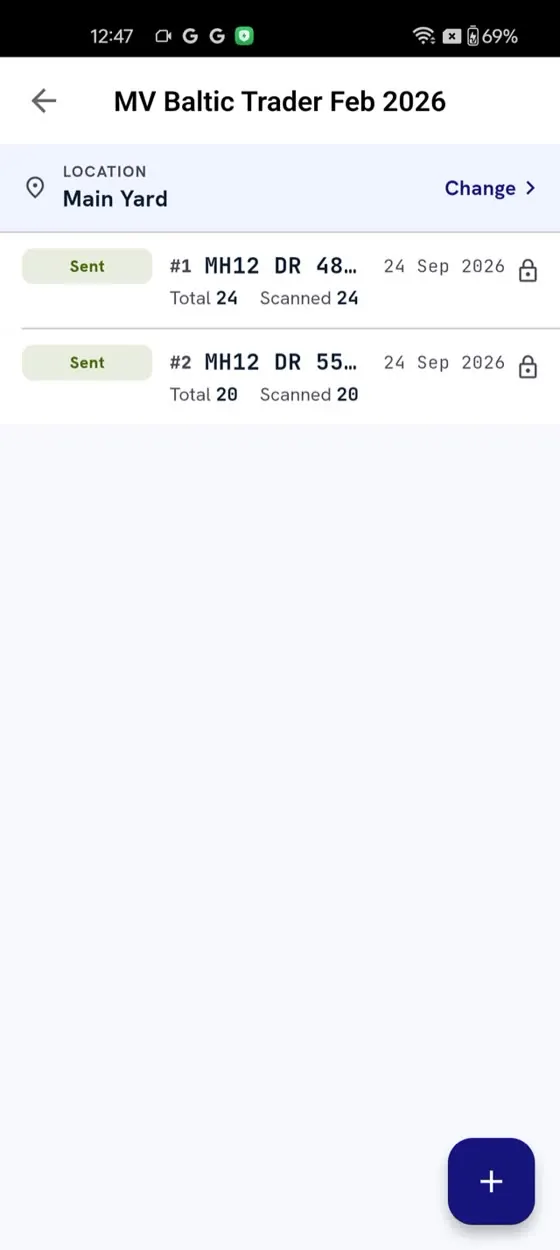
From the supplier’s list to stock you can sell
The packing list, loaded once
Bring in the supplier’s list for the consignment: every log or bundle with its number, grade, length and volume as you were billed. Everything after that is checked against it.
Every lorry checked at the gate
The gateman scans each tag as the lorry is unloaded. By evening you know which logs came, which did not, and which arrived with no tag at all.
Shortage with proof
What is short against the list is on record by consignment and by lorry, with the logs named. That is what a claim on the port, the transporter or the supplier needs.
Bought volume beside your own measure
The volume you paid for stays as the supplier gave it. What your yard or your saw measures sits beside it, so the difference is a figure, not an argument.
Stock by consignment, size and yard
See how much of each vessel is still in the yard, how much has been sawn or sold, and what you hold by species, grade and size in CFT and CBM.
Orders, loading and challans
Sell from that stock. An order becomes a loading list, the loading list becomes a challan, and the challan takes the timber off stock.
Running in a week
- Set up in a dayWe set up your company, users, species and sizes, and load one of your current consignments from the supplier’s list.
- Receive one vessel with usYour gate team takes the lorries of a real consignment through on their own phones, with us at the yard.
- Run every consignment on itFrom then on each vessel has its own record: what was bought, what arrived, what is left and what was sold.
“We received a shortage of 26 metres of logs from the port and found it was in non-tally logs. I claimed the shortage from the port. I can see the work done by munshis and whether they are doing the right job.”
Questions
What is timber import software?
Software for a business that buys timber by the vessel or the container and sells it from a yard. It holds the supplier’s packing list, checks what really arrives against it, and keeps stock by consignment, so the importer knows what was short and what each consignment still holds.
How does it find a shortage?
The supplier’s list is loaded before the timber arrives. At the gate each tag is scanned as the lorry is unloaded, so anything on the list that was never scanned shows as short, by lorry and by consignment.
What about logs with no tag?
They are still received and recorded as untagged. They can be matched to their consignment later, so a torn tag does not become missing timber.
Does it work for sawn timber as well as logs?
Yes. Round logs and sawn timber in bundles are both received, held and sold, each in its own units.
Does it handle customs and shipping documents?
No. Timbba starts where the timber reaches you: the gate, the yard, the saw and the customer. Customs paperwork and accounts stay with your clearing agent and your accounting software.
How is it priced?
By the size of the operation, as a yearly subscription. Indian plans start at ₹6,250 a month, and the pricing section on the home page has the details.
Check your next vessel against its list
A demo with one of your own consignments, from the packing list to the gate. Plans from ₹6,250 a month.